

Your brand’s visibility in AI search has become the new SEO battleground, and if you’re not monitoring it, you’re already behind. The seismic shift from Google’s search monopoly to AI-powered engines like ChatGPT, Perplexity, Claude, and Gemini has fundamentally changed how people discover brands, products, and information in 2026. The problem? Traditional SEO tools like Google Analytics, SEMrush, and Ahrefs don’t track citations in AI-generated responses, leaving a massive blind spot in your marketing strategy. In this comprehensive guide, we’ll reveal the best AI search monitoring tools that help you track brand mentions, analyze competitor visibility, and optimize your content to dominate AI search results – plus, we’ll show you why using privacy-first browsing with Herond Browser is essential when researching competitors’ AI visibility to keep your monitoring strategy confidential and secure.
Understanding AI Search Monitoring: What’s Changed
The AI Search Revolution
How Traditional Search Used to Work
Remember the old way of searching? You’d type something into Google or Bing, get ten blue links, and start clicking through to piece together your answer. Search engine optimization was all about gaming. The algorithm – build enough backlinks, stuff the right keywords, optimize your meta tags, and maybe, just maybe, you’d hit that #1 ranking and watch the traffic roll in. It was predictable, measurable, and entirely focused on getting people to click through to your website.
The AI Search Takeover: ChatGPT, Perplexity, and Beyond
Now? People are skipping Google entirely and asking ChatGPT, Perplexity, Claude, Gemini, or Microsoft Copilot instead. These AI search engines don’t give you ten links to explore – they give you the answer, synthesized from multiple sources, delivered in natural conversation. Users ask a question and get a comprehensive response without clicking anywhere. It’s faster, more convenient, and fundamentally different from traditional search, which is exactly why adoption is skyrocketing and why brands need to pay attention.
Citations Are the New Rankings
Here’s what most marketers are missing: in AI search, being cited is worth more than ranking #1 ever was. When ChatGPT mentions your brand in its response to “What’s the best project management tool?” you’ve just been recommended directly to someone actively looking for a solution. No competing with nine other results. No SEO games. Just pure, trusted visibility at the exact moment someone is making a decision. That’s the citation economy – and it’s more powerful than any SERP position.
This Isn’t Optional Anymore
If your brand isn’t showing up in AI search results, you’re invisible to a massive and growing segment of your market. Millions of people have already made AI their default search method, and that number is doubling every few months. While you’re focused on Google rankings, your competitors are getting cited by ChatGPT, recommended by Perplexity, and trusted by Claude. The gap is widening every day, and brands that wait to address AI search visibility will find themselves playing catch-up in a race they can’t win.
What are The Best AI Search Monitoring Tools?
Definition
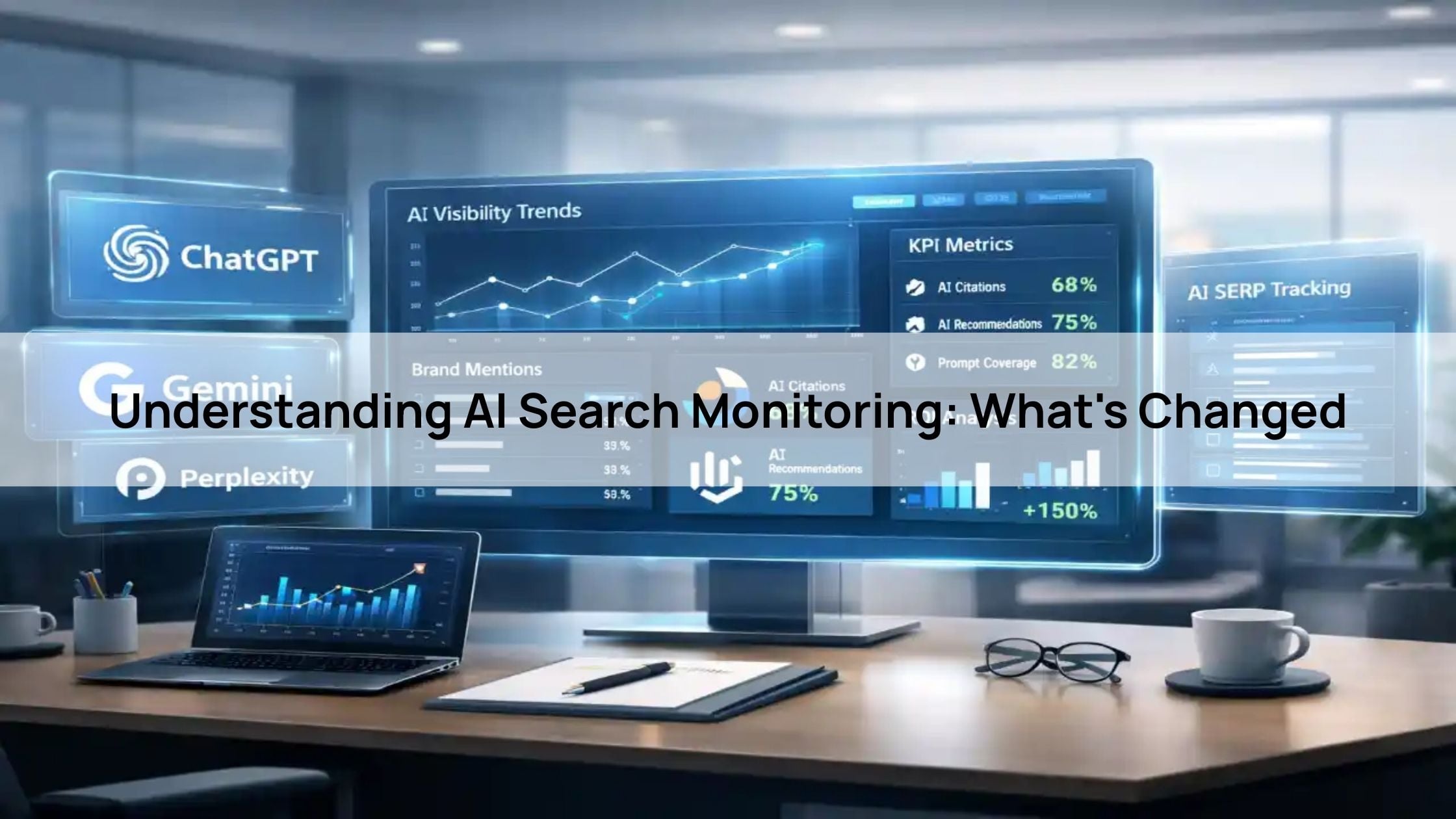
AI search monitoring is the practice of tracking how often and where your brand appears in AI-generated responses from ChatGPT, Perplexity, Claude, Gemini, and other conversational search engines, revealing whether AI platforms cite, recommend, or ignore your brand when users ask for information.
Key metrics
Citation Quality
Citation quality evaluates whether AI presents your brand as a top recommendation, neutral option, or negative example. Context matters more than counts.
Share of Voice
Share of voice calculates your percentage of industry citations versus competitors, revealing whether you’re winning or losing AI visibility battles.
Source Attribution
Source attribution tracks whether AI correctly credits your brand when using your research, data, or insights in generated responses.
Topic Coverage
Topic coverage identifies which queries trigger AI to mention your brand, mapping where you dominate versus where you’re invisible.
Sentiment Analysis
Sentiment analysis categorizes citations as positive, neutral, or negative, revealing reputation trends beyond raw mention frequency.
Why Traditional SEO Tools Fall Short
Your Analytics Dashboard Is Lying to You
Google Analytics shows you website traffic, but it’s completely blind to ChatGPT, Perplexity, and Claude activity, meaning when AI engines recommend your brand to millions of users, you see nothing. These AI-powered brand exposures don’t generate clicks or pageviews, so they never appear in your analytics. You could be getting cited hundreds of times daily in AI responses, influencing purchase decisions at scale, and your analytics would show zero activity because AI search operates outside the traditional click-based measurement model.
Your SEO Tools Are Measuring the Wrong Battlefield
SEMrush and Ahrefs track where you rank on Google, but they can’t tell you if ChatGPT is recommending your competitors instead of you when users ask buying questions. These tools monitor the old search paradigm while millions of users have moved to conversational AI, leaving you with detailed data about a shrinking channel and zero visibility into the growing one. Traditional SEO platforms weren’t built for AI citations and can’t adapt to measure them effectively.
Ranking #1 Doesn’t Mean Being Mentioned
You can dominate Google rankings and still be invisible in AI search because conversational platforms don’t show ranked lists, they generate single answers. ChatGPT might cite your competitor when asked “what’s the best solution” even though you rank #1 for that keyword on Google. AI engines evaluate content through different lenses than traditional search algorithms, making your hard-won keyword positions irrelevant on the platform where users are increasingly going for recommendations.
Traditional Metrics Can’t Measure AI Success
Citation frequency, share of voice, sentiment analysis, and topic coverage. These are the metrics that matter in AI search, and traditional SEO tools don’t measure any of them. The KPIs that drove your SEO strategy for years (rankings, traffic, CTR) don’t translate to conversational AI where success means being selected for synthesis and cited as authoritative. Measuring AI search performance requires new tools built for new metrics, not dashboards designed for the Google era.
Who Needs What Are The Best AI Search Monitoring Tools
Brands: Reputation & Competition
Brands monitor AI search to protect reputation, track misinformation, and measure competitive share of voice across ChatGPT, Perplexity, and Claude.
Publishers: Content Citation Tracking
Publishers need to know if AI engines cite their original content or competitors’, proving journalism value and guiding editorial strategy.
SEO Pros: Client Expectations
SEO professionals must report AI visibility alongside Google rankings to meet client expectations and demonstrate comprehensive search performance.
E-commerce: Shopping Recommendations
E-commerce brands track whether AI engines recommend their products when users ask buying questions, capturing high-intent shoppers.
SaaS: Software Comparisons
SaaS companies monitor AI feature comparisons to ensure accurate representation and competitive positioning in software evaluation queries.
Agencies: Multi-Client Efficiency
Agencies need scalable AI monitoring supporting multiple clients with white-label reporting for efficient service delivery across portfolios.
Comprehensive Tool Comparison – What Are The Best AI Search Monitoring Tools
Feature Comparison Matrix
| Feature | Profound | BrightEdge | Originality | Semrush | AIContentfy | DIY |
| AI Engines Tracked | 5+ | 4+ | 3 | 3-Feb | 3 | Custom |
| Citation Tracking | ✓✓✓ | ✓✓✓ | ✓✓ | ✓✓ | ✓ | ✓✓✓ |
| Competitor Analysis | ✓✓✓ | ✓✓✓ | ✓✓ | ✓✓ | ✓ | ✓✓ |
| Query Intelligence | ✓✓✓ | ✓✓ | ✓ | ✓✓ | ✓ | ✓✓✓ |
| Sentiment Analysis | ✓✓✓ | ✓✓ | ✓✓ | ✓ | ✓ | ✓✓ |
| API Access | ✓ | ✓ | ✗ | ✓ | ✗ | Native |
| White-Label Reports | ✓ | ✓ | ✓ | ✗ | ✗ | ✓ |
| Price (Starting) | $99 | $$$$ | $29 | +$50 | $19 | Variable |
| Ease of Use | Medium | Hard | Easy | Medium | Easy | Hard |
| Support Quality | Excellent | Excellent | Good | Good | Fair | DIY |
Pricing Comparison – What Are The Best AI Search Monitoring Tools
| Tool | Entry Price | Mid-Tier | Enterprise | Free Trial |
| Profound | $99/mo | $299/mo | Custom | 14 days |
| BrightEdge | Custom | Custom | Custom | Demo only |
| Originality | $29/mo | $99/mo | $299/mo | 7 days |
| Semrush | +$50/mo | +$100/mo | Custom | No |
| AIContentfy | $19/mo | $49/mo | $99/mo | 7 days |
| DIY | $100+/mo | Variable | Variable | N/A |
Conclusion
The AI search monitoring landscape in 2026 offers solutions for every budget and use case, from Profound’s enterprise-grade platform to AIContentfy’s affordable starter plans. Traditional SEO tools cannot track ChatGPT, Perplexity, Claude, or Gemini citations, creating blind spots that specialized AI monitoring tools fill with citation tracking, competitive analysis, and sentiment monitoring. Choose Profound for comprehensive features, Originality.AI for publisher needs, or AIContentfy for budget-friendly monitoring. Start with free trials, test your brand visibility, select the right tool, and begin optimizing for AI citations immediately. Protect your competitive research with Herond Browser’s privacy-first browsing. The brands monitoring AI search today will dominate tomorrow’s citation economy, don’t wait until competitors have built insurmountable advantages. Start monitoring now.
About Herond
Herond Browser is a cutting-edge Web 3.0 browser designed to prioritize user privacy and security. By blocking intrusive ads, harmful trackers, and profiling cookies, Herond creates a safer and faster browsing experience while minimizing data consumption.
To enhance user control over their digital presence, Herond offers two essential tools:
- Herond Shield: A robust adblocker and privacy protection suite.
- Herond Wallet: A secure, multi-chain, non-custodial social wallet.
As a pioneering Web 2.5 solution, Herond is paving the way for mass Web 3.0 adoption by providing a seamless transition for users while upholding the core principles of decentralization and user ownership.
Have any questions or suggestions? Contact us:
- On Telegram https://t.me/herond_browser
- DM our official X @HerondBrowser
- Technical support topic on https://community.herond.org