


In 2026, the traditional SEO playbook was rewritten: being “ranked” on page one is no longer enough if you aren’t being “cited” by the AI agents users trust. Why Use AI Search Monitoring Tools is no longer a question of curiosity, but of survival, as these specialized platforms allow you to track brand mentions, citation frequency, and sentiment across ChatGPT, Gemini, and Google’s AI Overviews. By leveraging these tools, you can bridge the visibility gap between blue links and generative answers, ensuring your brand remains a primary source in an era where AI-driven “zero-click” searches dominate the user journey.
Visibility in the “Answer Engine” Era
Tracking Brand Citations
In the age of conversational answers, appearing in a list of blue links is secondary to being the primary recommendation in an AI’s chat window. Why Use AI Search Monitoring Tools is simple: they allow you to quantify how often models like ChatGPT, Claude, and Gemini cite your brand as a trusted authority. By tracking these citations across thousands of simulated prompts, you gain a clear view of your “AI referral rate,” ensuring your brand isn’t just invisible background noise but a top-of-mind suggestion for the world’s most popular digital agents.
Share of Voice (SoV) in AI Overviews
Google’s AI Overviews have fundamentally shifted user attention from organic results to a single, synthesized summary at the top of the page. Understanding Why Use AI Search Monitoring Tools becomes critical when you need to measure your Share of Voice (SoV) within these high-visibility blocks. These tools calculate exactly how much “real estate” your content occupies in AI-generated summaries compared to your competitors, allowing you to optimize your technical structure and E-E-A-T signals to reclaim lost traffic in a zero-click environment.
Sentiment Analysis
AI models don’t just cite brands; they describe them, and those descriptions can shape public perception in seconds. One major reason why I use AI search monitoring tools is to perform automated sentiment analysis on the adjectives and tone an AI uses when discussing your products. Whether an AI perceives your brand as “innovative” or “expensive,” these tools alert you to shifts in AI sentiment or potential hallucinations, giving you the insights needed to adjust your content strategy and correct the narrative before an AI-driven reputation crisis takes hold.
Competitive Intelligence & Gap Identification
Reverse-Engineering Recommendations
The “black box” of AI decision-making becomes transparent when you understand Why Use AI Search Monitoring Tools for competitive intelligence. In 2026, these tools allow you to deconstruct exactly why an AI model like Claude or Perplexity prioritizes a competitor’s page over yours, whether it’s due to a specific data-rich study, a machine-readable table, or a high-authority Reddit citation. By reverse-engineering these “power pages,” you can identify the structural and semantic patterns that trigger AI recommendations, transforming competitor success into a repeatable blueprint for your own content strategy.
Content Gap Discovery
One of the most strategic reasons Why Use AI Search Monitoring Tools is to pinpoint “blind spots” where your brand is currently invisible to AI agents. These platforms run thousands of simulated buyer-intent queries to identify specific conversational prompts and long-tail questions where competitors are cited but you are not. By uncovering these gaps, you can shift from generic keyword targeting to Agentic SEO, creating high-value content that answers the exact questions AI models are actively searching for to satisfy user intent.
Benchmarking
In a volatile search landscape where AI responses can change by the hour, Why Use AI Search Monitoring Tools comes down to having a reliable “AI Search Score.” These tools provide a standardized benchmark of your brand’s visibility, citation share, and referral potential against industry leaders in real-time. Instead of guessing your impact, you get a data-backed view of how your Generative Engine Optimization (GEO) efforts are moving the needle, allowing you to report on “Share of Voice” within AI Overviews with the same precision as traditional rank tracking.
Improving Content Extraction & “Agentic” SEO
Monitoring Extractability
In 2026, content is only as good as an AI’s ability to parse it. High-performing monitoring tools analyze your site’s “extractability,” ensuring that technical structures like Schema markup, nested FAQs, and bulleted lists are optimized for Large Language Models (LLMs). By verifying that your data is machine-readable, these tools help you secure the top spot in AI Overviews and conversational snippets, turning your static web pages into ready-to-use answers for digital agents.
Verifying Authority Signals
Modern search engines and AI models prioritize Experience, Expertise, Authoritativeness, and Trustworthiness (E-E-A-T) above all else. Specialized monitoring platforms track how AI “perceives” your brand’s authority by analyzing the sentiment and context of its citations across the web. This allows you to identify whether an AI views your brand as a primary expert or a secondary source, giving you the data needed to strengthen your authorship signals and professional credentials where they matter most.

Source Attribution
Understanding exactly which resources, whether blog posts, whitepapers, or PDFs are used to “ground” an AI’s response is vital for a successful content strategy. Monitoring tools provide deep insights into source attribution, revealing which specific pages are consistently cited as the factual basis for AI answers. This visibility allows you to double down on high-performing assets and optimize your most authoritative documents to ensure they remain the preferred reference for AI-driven search results.
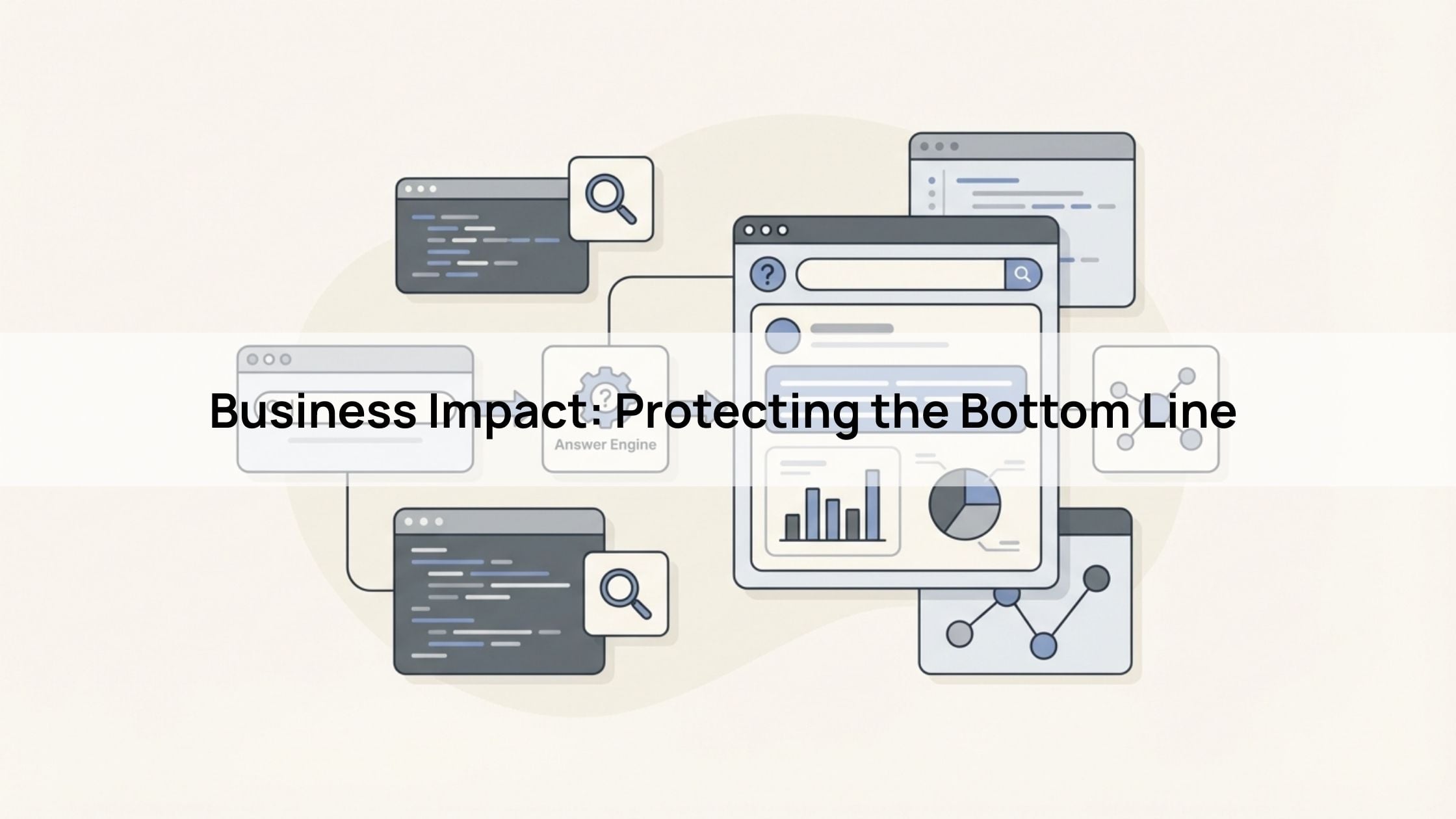
Business Impact: Protecting the Bottom Line
Revenue at Risk
In 2026, failing to appear in AI-generated answers directly translates to lost income. Advanced AI search monitoring tools now include “Revenue at Risk” calculators that estimate the traffic and conversion loss caused by a competitor’s dominance in AI Overviews. By identifying exactly how many high-intent queries are being diverted to other brands, marketing teams can prioritize their optimization efforts and secure their share of the trillion-dollar generative search market
Reputation Management
AI models are not infallible; they can “hallucinate” incorrect facts or perpetuate outdated biases about your brand. Continuous monitoring allows companies to detect misinformation or negative sentiment within AI responses before it scales. By identifying these inaccuracies early, brands can push for “grounding” updates and deploy targeted content strategies that provide the correct, authoritative data needed to refine the AI’s training set and protect brand equity.
SEO Efficiency
The days of manually typing prompts you into ChatGPT to see if your brand appears are over. AI monitoring tools automate the “heavy lifting” by running millions of simulated queries across multiple LLMs and geographic regions simultaneously. This level of SEO efficiency provides a macro-view of your search performance that human audits simply cannot match, freeing up your team to focus on high-level content strategy rather than tedious manual testing.
Conclusion
Ultimately, the rise of “Answer Engines” means that visibility is no longer just about where you rank, but how you are remembered and cited by the AI models users trust. Why Use AI Search Monitoring Tools is simple: in 2026, these platforms provide the only reliable “Whole Market View” of your brand’s reputation and share of voice across the generative landscape. By turning the “black box” of AI decision-making into actionable data, you can protect your revenue from zero-click traffic loss, correct hallucinations before they spread, and ensure your brand remains a primary source of truth in the hybrid search era.
About Herond
Herond Browser is a cutting-edge Web 3.0 browser designed to prioritize user privacy and security. By blocking intrusive ads, harmful trackers, and profiling cookies, Herond creates a safer and faster browsing experience while minimizing data consumption.
To enhance user control over their digital presence, Herond offers two essential tools:
- Herond Shield: A robust adblocker and privacy protection suite.
- Herond Wallet: A secure, multi-chain, non-custodial social wallet.
As a pioneering Web 2.5 solution, Herond is paving the way for mass Web 3.0 adoption by providing a seamless transition for users while upholding the core principles of decentralization and user ownership.
Have any questions or suggestions? Contact us:
- On Telegram https://t.me/herond_browser
- DM our official X @HerondBrowser
- Technical support topic on https://community.herond.org