

An AI agent recently built a full-stack web application in 47 minutes, from architecture to deployment, with zero human intervention. This is not a glimpse into the future; it is the new reality of web development. Agentic AI has evolved rapidly from simple code assistants that suggested syntax, to fully autonomous builders that plan, write, test, and deploy entire applications end-to-end. As of Q1 2026, 18% of all web applications were built with significant AI agent involvement – a number that continues to climb. In this article, you will learn exactly what agentic AI web development is, how it works, who stands to benefit most. And also why it represents the most significant shift in web development since the cloud.
What is Agentic AI Web Development?
Definition
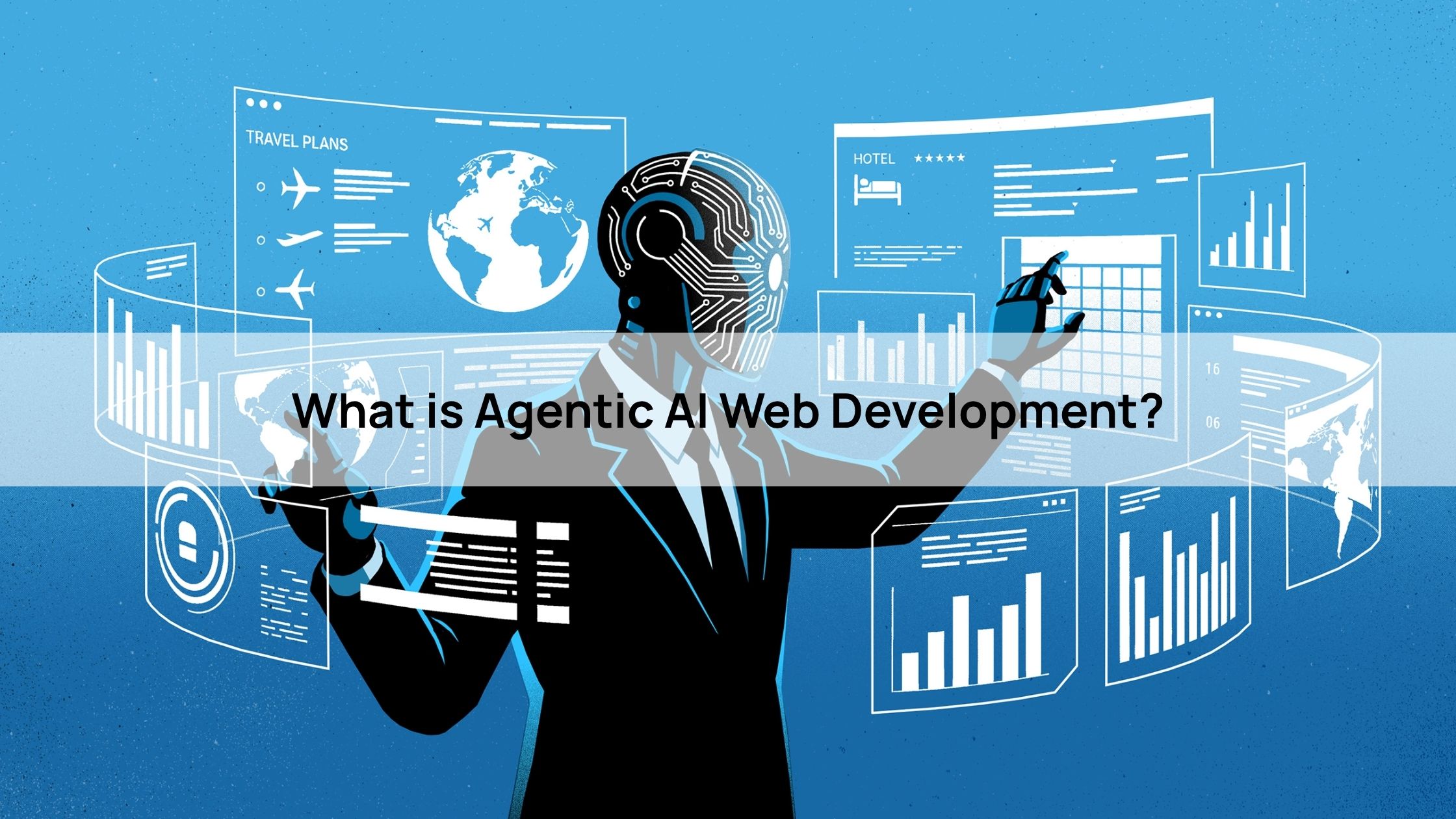
Agentic AI web development is the practice of using autonomous AI agents to plan, build, test, and deploy web applications with minimal human intervention. Unlike traditional AI coding tools that assist developers line by line, agentic AI operates independently, breaking down complex development goals into actionable steps, writing and debugging code across the full stack, and adapting in real time when problems arise.
Traditional AI vs. Agentic AI
| Feature | Traditional AI (e.g. Copilot) | Agentic AI |
| Primary Role | Code suggestion | Autonomous builder |
| Task Scope | Single-step assistance | Multi-step execution |
| Human Input | Constant guidance required | Minimal intervention needed |
| Decision Making | None – waits for instructions | Independent planning & reasoning |
| Code Generation | Line-by-line suggestions | Full application architecture |
| Testing & Debugging | Manual by developer | Automated end-to-end |
| Deployment | Developer-managed | Fully autonomous |
| Context Awareness | Limited to current file | Entire project scope |
| Adaptability | Static responses | Dynamic, self-correcting |
| Speed | Faster than writing alone | Dramatically faster end-to-end |
| Web3 Compatibility | Limited | Native support available |
| Best For | Assisted coding | Full-stack autonomous development |
How Agentic AI Web Development Works
The Technical Architecture
Intent understanding
The AI agent takes a high-level goal, whether a simple landing page or a complex decentralized application and interprets the full scope of what needs to be built. Using large language models and natural language processing. It transforms vague human instructions into precise, actionable development requirements, bridging the gap between what you want and what needs to be coded.
Planning phase
The planning phase is where agentic AI truly separates itself from traditional coding tools. Rather than waiting for the next instruction, the agent autonomously maps out the entire development roadmap, breaking the project into logical components, identifying dependencies, selecting the appropriate tech stack, and sequencing tasks in the most efficient order. It thinks before it builds, the way a seasoned architect would before laying a single brick.
Code generation
Once the plan is in place, the agent writes clean, functional, production-ready code across the full stack: front end, back end, database, and API layers, simultaneously and at speed no human developer can match. It doesn’t generate suggestions for you to approve; it generates complete, deployable code ready for the next stage.
Testing & debugging
Testing and debugging happen automatically, without a developer ever opening a terminal. The agent runs comprehensive tests across every layer of the application, identifies errors, diagnoses root causes, and applies fixes in real time, iterating until the code meets the required standard. What once consumed hours of a developer’s time is reduced to a seamless, self-correcting process handled entirely by the AI.
Deployment
Deployment is the final step, and with agentic AI, it is just as autonomous as everything that came before it. The agent configures the environment, manages dependencies, and deploys the application to the target infrastructure without manual intervention.
Technology Stack Enabling This
LLMs (GPT-4, Claude, Llama)
Large Language Models (LLMs) are the cognitive core of every agentic AI web development system. Models like GPT-4, Claude, and Llama provide the reasoning, language understanding, and code generation capabilities that make autonomous development possible. Each brings its own strengths, GPT-4 for broad capability, Claude for nuanced reasoning and safety, and Llama for open-source flexibility.
Execution environments
Execution environments are where the AI agent’s plans come to life. These are sandboxed, containerized runtime environments, such as Docker, cloud-based virtual machines, and serverless compute platforms – where agentic AI writes, runs, and iterates on code in real time. A capable execution environment gives the agent the freedom to test, break, fix, and rebuild without impacting production systems, creating a safe and efficient workspace for fully autonomous development.
Version control integration
Version control integration keeps every action the AI agent takes transparent, trackable, and reversible. By connecting directly to platforms like GitHub and GitLab, agentic AI systems commit code changes, manage branches, and maintain a complete development history, just as a human developer would. This integration ensures that every decision made by the agent is documented, auditable, and easy to roll back if needed, bringing accountability to autonomous development.
Deployment platforms
Deployment platforms are the final layer that transforms AI-generated code into live, functioning web applications. By integrating with platforms like Vercel, AWS, Google Cloud, and Netlify, agentic AI agents can autonomously configure infrastructure, manage environment variables, and push fully tested applications to production, completing the entire development lifecycle without a single manual deployment step from the developer.
Leading Agentic AI Development Tools (2026)
Feature comparison table
| Feature | Devin | GPT-Engineer | Smol AI | AutoGPT | Claude Code | Copilot Workspace |
| Full Autonomy | ✅ Full | ⚡ Partial | ⚡ Partial | ⚡ Partial | ✅ Full | ⚡ Partial |
| Multi-step Planning | ✅ Yes | ✅ Yes | ❌ Limited | ✅ Yes | ✅ Yes | ⚡ Basic |
| Full-stack Generation | ✅ Yes | ✅ Yes | ⚡ Partial | ⚡ Partial | ✅ Yes | ⚡ Partial |
| Auto Testing & Debugging | ✅ Yes | ⚡ Partial | ❌ No | ⚡ Partial | ✅ Yes | ⚡ Partial |
| Auto Deployment | ✅ Yes | ⚡ Partial | ❌ No | ⚡ Partial | ⚡ Partial | ❌ No |
| Version Control Integration | ✅ Yes | ✅ Yes | ⚡ Partial | ✅ Yes | ✅ Yes | ✅ Yes |
| Natural Language Input | ✅ Yes | ✅ Yes | ✅ Yes | ✅ Yes | ✅ Yes | ✅ Yes |
| Web3 Compatibility | ⚡ Partial | ⚡ Partial | ❌ No | ⚡ Partial | ⚡ Partial | ❌ No |
| Open Source | ❌ No | ✅ Yes | ✅ Yes | ✅ Yes | ❌ No | ❌ No |
| IDE Integration | ⚡ Partial | ❌ No | ❌ No | ❌ No | ✅ Yes | ✅ Yes |
| Context Window | Large | Medium | Small | Medium | Large | Medium |
| Self-correction | ✅ Yes | ⚡ Partial | ❌ No | ⚡ Partial | ✅ Yes | ❌ No |
| API Access | ✅ Yes | ✅ Yes | ✅ Yes | ✅ Yes | ✅ Yes | ✅ Yes |
| Multi-language Support | ✅ Yes | ✅ Yes | ⚡ Partial | ✅ Yes | ✅ Yes | ✅ Yes |
| Best For | Enterprise | Startups | Prototypes | Automation | Professional devs | Assisted coding |
The Skill Shift
Old skills (declining)
The old skills are declining – not disappearing, but rapidly losing their premium value. Manual code writing, repetitive debugging, boilerplate configuration, and syntax memorization are no longer the differentiators they once were. As agentic AI tools take over the mechanical layers of development, the market demand for developers who spend their days writing line-by-line code is shrinking.
New skills (rising)
The new skills rising to the top are fundamentally different in nature. In the agentic AI era, the most valuable developers are those who can think in systems, crafting precise prompts, orchestrating multi-agent workflows, evaluating AI-generated output for quality and security, and architecting solutions at a level of abstraction that AI cannot yet reach alone.Skills like AI agent configuration, prompt engineering, Web3 integration, and agentic pipeline management are quickly becoming the new literacy of modern web development.
The Future: Where This is Going
2026-2027: Near-term
The Acceleration Phase. Agentic AI web development moves from early adoption to mainstream practice. The majority of startups and tech-forward enterprises begin integrating agentic AI into their core development workflows, driven by dramatic reductions in build time and cost. Tooling matures rapidly with platforms like Devin, Claude Code, and emerging competitors offering more reliable, full-stack autonomy. Web3 compatibility becomes a standard feature, not an add-on, as decentralized applications surge in demand. Developer roles begin shifting visibly, with prompt engineering and agent orchestration becoming core job requirements across the industry.
2027-2029: Mid-term
The Normalization Phase. Agentic AI is no longer a competitive advantage, it is the baseline expectation. Development teams shrink as AI agents handle the majority of routine build, test, and deployment tasks autonomously. New frameworks and standards emerge specifically for managing multi-agent development pipelines, and regulatory bodies begin introducing guidelines around AI-generated code quality and accountability.
2030+: Long-term
The Autonomous Web Phase. The internet itself becomes largely self-building. AI agents design, develop, deploy, and maintain web applications with minimal human input, adapting in real time to user behavior, security threats, and evolving business requirements. The concept of a traditional development team is fundamentally redefined, with small groups of highly skilled AI architects overseeing vast networks of autonomous agents building at a scale previously unimaginable.
How Herond Leverages Agentic AI
Herond’s Development Approach
AI-assisted browser development
AI-assisted browser development is at the core of how Herond builds the next generation of the agentic web. Rather than relying solely on traditional development workflows, Herond leverages agentic AI throughout its entire development process, accelerating feature development, optimizing performance, and continuously improving the browsing experience at a pace that manual development alone could never achieve.
Quality controls
Quality controls ensure that every AI-assisted output meets Herond’s exacting standards before it ever reaches the user. Automated testing pipelines, rigorous code review processes, and multi-layer security audits are built directly into Herond’s development workflow, catching errors, identifying vulnerabilities, and validating performance at every stage. AI may accelerate build, but quality is never sacrificed for speed.
Human oversight
Human oversight remains the guiding force behind everything Herond builds. While agentic AI handles the heavy lifting of development, Herond’s team of engineers, security experts, and Web3 specialists maintain strategic control over every major decision, ensuring that the browser evolves in alignment with its core mission of serving humanity. AI builds faster; humans build better. At Herond, the two work together with human judgment, creativity, and accountability, always at the helm.
Building on Herond
Developer tools
Developer tools built into Herond give developers everything they need to build, test, and deploy directly within the world’s first Agentic Browser for Web3. From advanced debugging consoles and performance profiling to native Web3 development utilities, Herond’s developer toolkit is designed to meet the demands of modern web and decentralized application development.
AI integration APIs
AI integration APIs open up the full power of Herond’s agentic AI layer to developers building on top of the platform. With clean, well-documented APIs, developers can tap directly into Herond’s AI reasoning, task automation, and natural language processing capabilities, embedding intelligent, autonomous functionality into their own applications and services.
Extension development with AI
Extension development with AI takes browser customization to an entirely new level on Herond. Developers can build, test, and deploy AI-powered extensions that leverage Herond’s agentic capabilities, creating tools that reason, automate, and adapt in real time to user behavior.
Conclusion
Agentic AI web development is not a trend to watch, it is a transformation already underway. From autonomous full-stack builders and self-correcting code pipelines to AI-powered browsers like Herond redefining how the web is built and experienced, the shift is real, rapid, and irreversible. The developers, teams, and organizations that embrace agentic AI today will build faster, smarter, and leaner than anything traditional development could deliver.
About Herond
Herond Browser is a cutting-edge Web 3.0 browser designed to prioritize user privacy and security. By blocking intrusive ads, harmful trackers, and profiling cookies, Herond creates a safer and faster browsing experience while minimizing data consumption.
To enhance user control over their digital presence, Herond offers two essential tools:
- Herond Shield: A robust adblocker and privacy protection suite.
- Herond Wallet: A secure, multi-chain, non-custodial social wallet.
As a pioneering Web 2.5 solution, Herond is paving the way for mass Web 3.0 adoption by providing a seamless transition for users while upholding the core principles of decentralization and user ownership.
Have any questions or suggestions? Contact us:
- On Telegram https://t.me/herond_browser
- DM our official X @HerondBrowser
- Technical support topic on https://community.herond.org