

The 2025 explosion of AI agents has flooded Web3 with tools promising autonomous DeFi trades, NFT scouting, and 24/7 wallet security, yet choosing the wrong one risks data leaks, slow execution, or missed yields in a hype-driven market. This guide evaluates top contenders like Herond’s privacy-first Agentic Browser across autonomy, Web3 compatibility, speed, and ROI, helping you select the best AI agent for seamless, secure decentralized power.
What Are AI Agents?
AI agents are autonomous systems that perceive environments, make decisions, and execute tasks independently – key characteristics include reasoning, learning, and goal-oriented action, setting them apart from chatbots that only react to prompts with static responses. They come in types like personal assistants for daily tasks, coding agents for software development, browsing agents for web navigation, and workflow automation for business processes, marking an evolution from reactive AI to proactive intelligence that anticipates and acts on user needs.

Comparison Framework
- Autonomy level: How independently they operate
- Task capabilities: Range of actions they can perform
- Privacy & security: Data handling and user control
- Integration: Compatibility with tools and platforms
- Cost: Pricing models and value proposition
- Use cases: Best fit scenarios
Personal Assistant AI Agents
| Feature | ChatGPT | Claude | Gemini | Microsoft Copilot | Google Assistant |
| Core capabilities and strengths | GPT-4o-powered conversational fluency, creative writing, fast responses, memory features | Constitutional AI for ethical reasoning, 200K token context, safe code generation | Multimodal reasoning, image/video analysis, custom Gems, Google Workspace integration | GPT integration with Microsoft 365, code suggestions in Bing/Edge, image generation via DALL-E | Voice-first AI with Google Search integration, smart home control, real-time translation |
| Best use cases | Brainstorming, emails, casual coding, content generation | Research writing, complex analysis, enterprise workflows | Deep research, data analysis, professional content, Google tasks | Office productivity, web research, coding assistance | Daily tasks, reminders, smart device control, quick queries |
| Limitations | Hallucinations, context limits, internet-dependent | Free tier limits, less multimodal | Latency under load, ecosystem lock-in, biases | Microsoft ecosystem dependency, variable accuracy | Limited reasoning depth, voice-focused, privacy concerns |
| Privacy considerations | Data may train models (opt-out available); Enterprise SOC 2/encryption | No API data for training by default, business-focused | Enterprise-grade encryption/compliance | Enterprise Azure AD security, data retention options | Google account data usage, opt-out for personalization |
| Pricing | Free, Plus $20/mo, Pro $200/mo, Enterprise custom | Free, Pro $20/mo, Max $100-200/mo, Team $30/seat, Enterprise | Free, AI Pro ~$20/mo, Enterprise scalable | Free, Pro $20/user/mo via Copilot Pro, Enterprise licensing | Free with Google account, premium via Nest devices |
Specialized AI Agents
Coding Agents
| Feature | GitHub Copilot | Cursor / Replit AI | Claude Code |
| Developer-focused features | Inline code completions, chat for debugging, multi-file awareness, GitHub integration | Full IDE with AI autocomplete, natural language code editing, agent mode for tasks, Replit’s cloud collab | Terminal-based code generation, step-by-step reasoning, artifact creation for apps, safe refactoring |
| IDE integration | VS Code, JetBrains, Neovim; seamless plugin | Cursor: VS Code fork with deep AI; Replit: browser IDE with Ghostwriter AI | Primarily CLI/terminal, integrates with any editor via API/extensions |
| Speed | Fast autocompletions (~100ms), but can lag on large repos | Cursor very responsive; Replit solid for cloud but network-dependent | Fast for small tasks, slower on complex reasoning chains |
| Accuracy | High for common patterns, prone to copy-paste errors | Strong context understanding, fewer hallucinations; Replit good for web dev | Excellent logical accuracy, safest for production code |
| Learning curve | Easy for VS Code users, prompt engineering helps | Steep for Cursor’s advanced modes; Replit beginner-friendly | Moderate; excels with clear instructions, conversational flow |
Research & Analysis Agents
| Feature | Perplexity AI | Consensus / Elicit | NotebookLM |
| Core capabilities | Real-time web search, AI-powered answer synthesis, cited sources, conversational follow-ups | Consensus: AI academic search engine aggregating paper findings; Elicit: Automated research workflows, literature reviews | Google’s AI for uploading docs/PDFs, generating audio overviews, study guides, timelines from personal notes |
| Search and synthesis | Combines search results into concise, cited answers; Pro adds deeper analysis and file uploads | Extracts key insights from 200M+ papers; synthesizes consensus on questions like “Does X cause Y?” | Analyzes uploaded documents, creates podcast-style summaries, extracts quotes/themes |
| Best for students | Quick homework answers with sources, explaining complex topics | Finding peer-reviewed evidence for essays, avoiding plagiarism | Organizing lecture notes, creating study guides, audio review sessions |
| Best for researchers | Literature scanning, trend identification, real-time updates | Systematic reviews, hypothesis testing, citation networks | Private doc analysis, first-pass paper synthesis, interview transcripts |
| Best for professionals | Market research, competitor analysis, fast fact-checking | Evidence-based decision making, whitepaper validation | Meeting notes synthesis, report generation, internal knowledge base |
| Key strengths | Speed, citations, free tier; always online knowledge | Academic rigor, 100% paper-sourced, reduces bias | Privacy-focused (your docs only), multimodal outputs, creative summaries |
| Pricing | Free, Pro $20/mo | Consensus: Free/$8.99/mo; Elicit: Free/$12/mo Pro | Free (Google account required) |
Workflow Automation Agents
| Feature | Zapier AI / Make | n8n |
| Core capabilities | Zapier: No-code AI actions, 7,000+ app integrations, natural language zap creation; Make: Visual scenarios with AI modules for data transformation | Open-source, self-hosted workflow automation with 400+ nodes, JavaScript customization, AI agent nodes |
| No-code automation | Drag-and-drop zaps with AI-powered triggers/actions; Make offers advanced logic branching and iterators | Node-based visual editor; less “no-code” than Zapier but fair-code licensed for easy self-hosting |
| Self-hosted option | Cloud-only; enterprise on-premise via Zapier Central | Fully self-hosted (Docker, npm), zero vendor lock-in, runs on your infrastructure |
| Business use cases | Lead routing to CRM, social media posting, email automation, AI content generation workflows | Custom ETL pipelines, internal tool integrations, API orchestration, monitoring/alerting |
| Productivity strengths | Speed for SMBs, massive app library, AI copilot for zap building | Cost-free scaling, data privacy control, complex multi-step logic |
| Pricing | Zapier: Free (limited), Starter $20/mo; Make: Free tier, Core $9/mo | Free core (self-hosted); Cloud starts ~$20/mo; enterprise support available |
| Best for | Non-technical teams needing quick integrations | DevOps teams wanting control, privacy, and unlimited usage |
Which AI Agent is Right for You?
General productivity
- ChatGPT (versatile content and task assistance)
- Zapier AI / Make (no-code workflow automation)
- Google Assistant (daily reminders and quick tasks)
Developers
- GitHub Copilot (inline code completions and debugging)
- Cursor / Replit AI (IDE-integrated AI coding)
- Claude Code (accurate terminal-based code generation)

Researchers
- Perplexity AI (real-time search and cited synthesis)
- Consensus / Elicit (academic paper analysis)
- NotebookLM (document synthesis and study guides)
Privacy-conscious users
- Herond Agentic Browser (self-custodial, on-device AI processing)
- Claude (no API data training by default)
- n8n (self-hosted workflows with full data control)
Web3 users
- Herond Agentic Browser (on-chain automation, DeFi trading, NFT management)
- Perplexity AI (Web3 research with citations)
- GitHub Copilot (smart contract and dApp development)
The Future of AI Agents
AI Agent Trends
AI agents are trending toward greater autonomy and seamless integration with everyday tools, evolving from single-task helpers to sophisticated systems that anticipate needs and handle multi-step processes across apps and devices.
Multi-Agent Collaboration
Multi-agent systems enable AI agents to collaborate like teams, dividing complex tasks such as market analysis plus execution, where one agent researches, another decides, and a third acts, boosting efficiency through specialization and real-time coordination.

Privacy-Preserving Techniques
Privacy-preserving AI techniques like federated learning, on-device processing, and zero-knowledge proofs ensure agents operate without exposing user data, keeping computations local or encrypted while delivering powerful insights.
Web3’s Role in AI Ecosystems
Web3 powers AI agent ecosystems through decentralized compute, token incentives, and blockchain verification, enabling trustless collaboration, monetizable agents, and Herond’s privacy-first browsers that fuse autonomy with on-chain security for a sovereign future.
Conclusion
From ChatGPT’s versatile conversations to Herond‘s autonomous Web3 browsing, the best AI agents empower you with tailored productivity, coding, research, and privacy, matching your needs in a rapidly evolving landscape. Herond Agentic Browser stands out for Web3 users seeking secure, on-chain automation that redefines decentralized workflows. Choose wisely, start experimenting today, and position yourself at the forefront of the agentic AI revolution where autonomy meets real-world impact.
About Herond
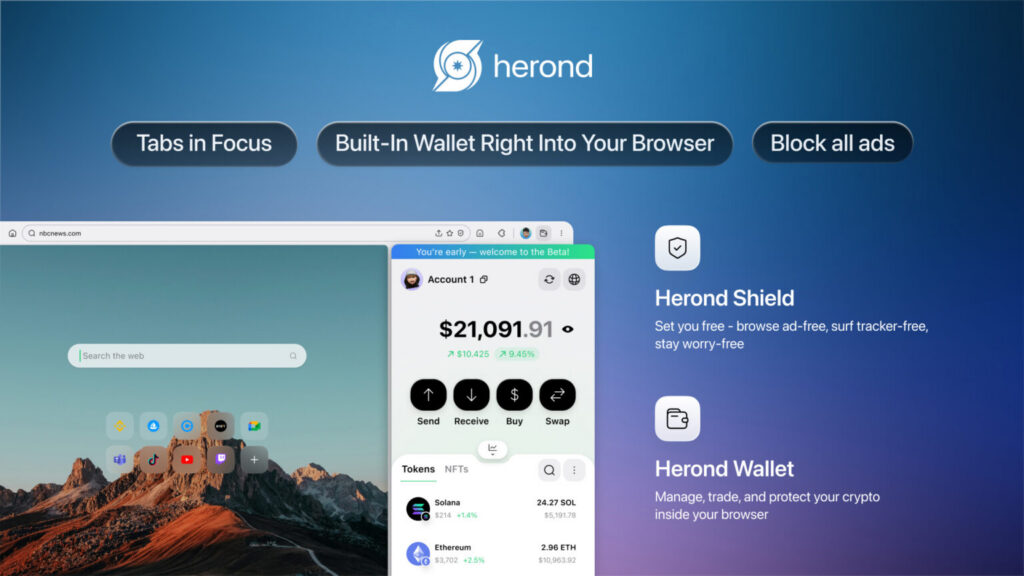
Herond Browser is a cutting-edge Web 3.0 browser designed to prioritize user privacy and security. By blocking intrusive ads, harmful trackers, and profiling cookies, Herond creates a safer and faster browsing experience while minimizing data consumption.
To enhance user control over their digital presence, Herond offers two essential tools:
- Herond Shield: A robust adblocker and privacy protection suite.
- Herond Wallet: A secure, multi-chain, non-custodial social wallet.
As a pioneering Web 2.5 solution, Herond is paving the way for mass Web 3.0 adoption by providing a seamless transition for users while upholding the core principles of decentralization and user ownership.
Have any questions or suggestions? Contact us:
- On Telegram https://t.me/herond_browser
- DM our official X @HerondBrowser
- Technical support topic on https://community.herond.org