


Traditional e-commerce still demands too much from us – we search, compare, click, and repeat, all manually. Agentic commerce changes that by putting AI agents in the driver’s seat: intelligent systems that discover, decide, and purchase on your behalf without a single click. This shift is happening now because three forces are converging at once – large language models capable of real-world reasoning, mature automation infrastructure, and consumers increasingly willing to delegate decisions to AI.
Enter Agentic Commerce: A New Definition
What does “agentic” mean?
Agentic refers to AI systems that can perceive goals, make decisions, and take actions autonomously, without requiring step-by-step human input. In commerce, an agentic AI doesn’t just recommend products; it researches options, compares prices, and completes purchases on your behalf.
Key capabilities
Autonomous product discovery & comparison
Instead of manually browsing multiple sites, AI agents scan thousands of listings across platforms in seconds. Filtering by your preferences, budget, and past behavior to surface only the most relevant options, fully without prompting.
Self-initiated purchasing based on rules/preferences
Users set conditions once – a price threshold, a preferred brand, a restock trigger. The agent executes the purchase automatically when those conditions are met. No cart, no checkout, no friction.
Real-time negotiation and deal-finding
Agentic systems actively monitor price fluctuations, apply coupons, switch payment rails for better rates. In some cases negotiate directly with sellers or platforms to secure the best deal in real time on your behalf.
Post-purchase management (returns, reviews, reorders)
The agent’s job doesn’t end at checkout. It tracks deliveries, flags issues, initiates returns when items don’t meet expectations, schedules reorders before you run out, and even submits reviews, turns post-purchase admin into a fully automated experience.
Why Agentic Commerce is the Next Frontier
The Shift from Browsing to Delegating
Consumer behavior is undergoing the most fundamental shift in the history of the internet. It moves from the “search and click” model that has defined web interaction for three decades to a new “set and forget” paradigm where AI agents handle the entire browsing, research, and purchasing workflow autonomously on the user’s behalf. They want to define a goal, delegate the execution to an intelligent agent, and receive the outcome. The browser is no longer a tool you operate; it is a service that operates for you.
Technology Enablers
The agentic commerce revolution is being built on four converging technology layers. Browser-use and computer-use AI give these models the ability to interact with the web the way a human would. Beneath it all, open commerce infrastructure and APIs provide the connective tissue that links agents to services, while voice and ambient computing are rapidly removing the last remaining friction point, making agentic commerce accessible through nothing more than a natural spoken request.
Business Model Disruption
Agentic commerce is dismantling the foundations of traditional digital marketing. As AI agents bypass search engine results pages, ignore banner ads, and skip the carefully engineered conversion funnels that businesses have spent decades optimizing. SEO, as we know, is evolving from ranking for human search queries to optimizing machine-readable product data that AI agents can discover, evaluate, and act on autonomously. In place of the traditional funnel emerges a new commercial paradigm: agent-optimized listings that speak directly to AI decision-making criteria, and an entirely new category of commerce, Business-to-Agent (B2A) – where businesses must learn to sell not to human shoppers, but to intelligent agents acting on their behalf.
Consumer Trust & Personalization at Scale
The most powerful promise of agentic commerce is not speed or automation, it is personalization at a level no human shopper can achieve alone. As AI agents interact with the web on your behalf, they continuously learn your preferences, refine their understanding of your priorities, and build an increasingly precise model of your tastes, budget, and decision-making patterns over time. The result is hyper-personalized purchasing that requires no manual input, an agent that already knows your preferred brands, acceptable price ranges, and quality standards before you even articulate them, delivering exactly the right outcome without ever asking you to start from scratch.
Challenges & Considerations
The rise of agentic commerce brings a set of critical challenges that the industry must confront honestly and urgently. Privacy and data security sit at the top of the list, when an AI agent acts on your behalf. It inevitably accumulates an extraordinarily detailed picture of your preferences, finances, and behavior that represents an unprecedented concentration of personal data requiring ironclad protection. Consumer trust remains an open question: handing purchasing power to an AI agent demands a level of confidence in its judgment, transparency, and alignment with user interests that the industry has not yet fully earned.
What Businesses Should Do Now
Beginning by auditing your commerce stack for agent-readiness, identifying where manual processes, closed systems. And unstructured product data create barriers that AI agents cannot navigate autonomously. Optimize your product listings and catalog data for machine consumption, structured data, clean APIs, and machine-readable specifications are no longer optional extras but the baseline requirements for visibility in an agent-driven discovery landscape. Design agentic UX, which gives users meaningful control over how agents act on their behalf, preference settings, approval flows, and spending limits that build trust and transparency essential for consumer adoption.
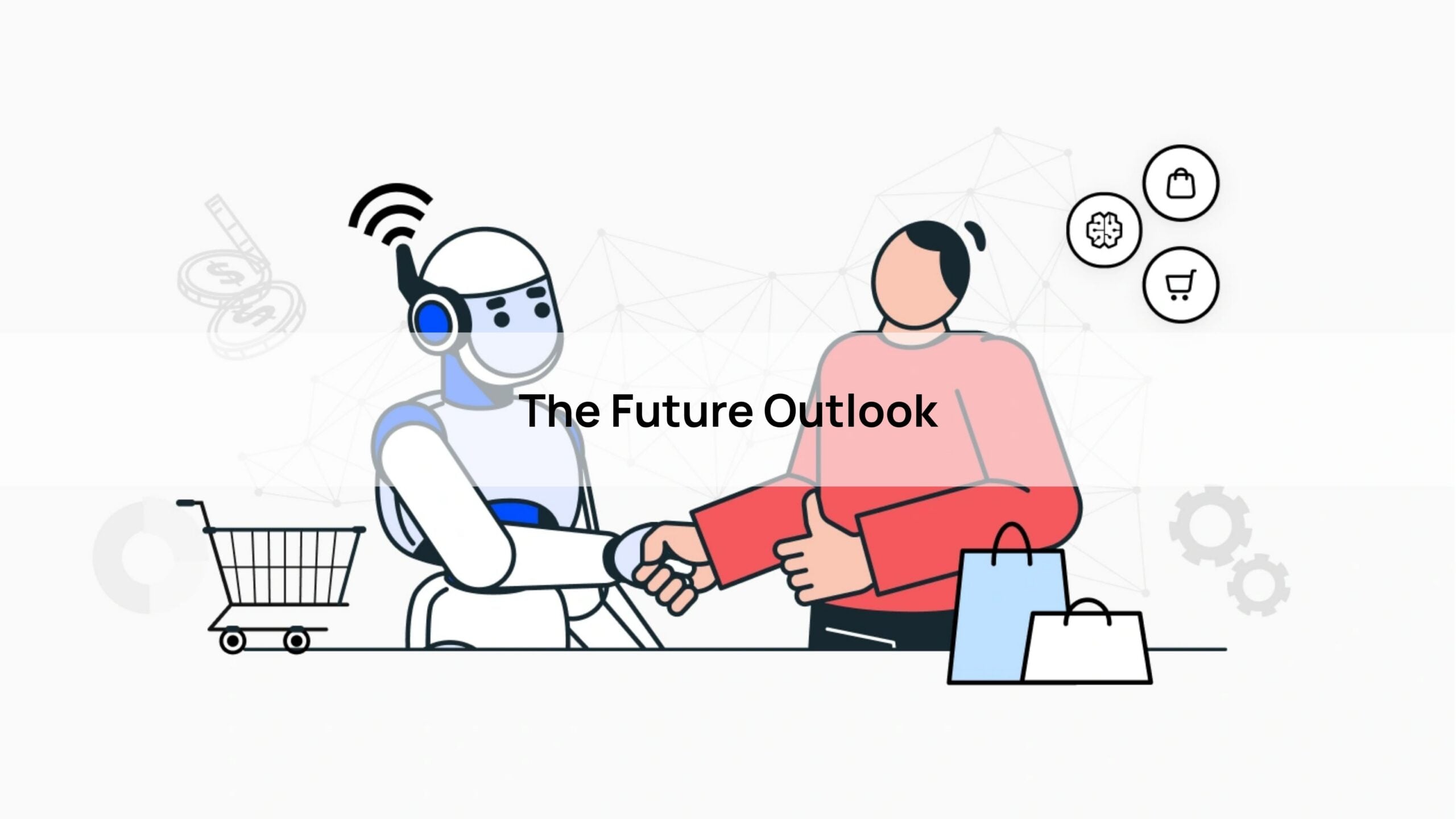
The Future Outlook
The agentic commerce market is poised for explosive growth, with projections suggesting it will represent a multi-trillion dollar share of global digital commerce within the next five years as adoption accelerates from early majority to mainstream across consumer and enterprise markets alike. Most significantly, AI agents are completing the most consequential evolution in the history of digital commerce, graduating from helpful assistants that suggest and inform, to fully autonomous economic actors that discover, negotiate, transact, and manage entire commercial relationships independently, fundamentally redefining what it means to participate in the digital economy.
Conclusion
Agentic commerce is not the next iteration of e-commerce, it is the replacement of it. The shift from “search and click” to “set and forget” is rewriting every rule of digital commerce, from product discovery and evaluation to transaction settlement and fulfillment. Businesses that fail to optimize AI agents, embrace open commerce infrastructure, and build consumer trust in autonomous purchasing will find themselves invisible in a landscape where machines make buying decisions. The frontier is open and the brands that move now will own it.
About Herond
Herond Browser is a cutting-edge Web 3.0 browser designed to prioritize user privacy and security. By blocking intrusive ads, harmful trackers, and profiling cookies, Herond creates a safer and faster browsing experience while minimizing data consumption.
To enhance user control over their digital presence, Herond offers two essential tools:
- Herond Shield: A robust adblocker and privacy protection suite.
- Herond Wallet: A secure, multi-chain, non-custodial social wallet.
As a pioneering Web 2.5 solution, Herond is paving the way for mass Web 3.0 adoption by providing a seamless transition for users while upholding the core principles of decentralization and user ownership.
Have any questions or suggestions? Contact us:
- On Telegram https://t.me/herond_browser
- DM our official X @HerondBrowser
- Technical support topic on https://community.herond.org