

In 2026, the artificial intelligence landscape has shifted: the era of Big Tech monopolies is fading as Decentralized AI (DeAI) takes center stage. Users are increasingly ditching “black-box” models in favor of these decentralized alternatives to regain control over their data, avoid censorship, and access high-performance intelligence without the oversight of a single corporate entity.
The Big Three Decentralized AI: Market Leaders in 2026
The DeAI landscape in 2026 is dominated by three powerhouses, each providing a critical layer of the decentralized intelligence stack: intelligence, compute, and execution.
Bittensor (TAO): The “Neural Network of Networks”
Bittensor has evolved into the definitive marketplace for machine intelligence. By 2026, it has expanded to over 50 specialized subnets, each acting as a competitive arena for specific AI tasks.
The Ecosystem
Unlike a single model, Bittensor is a framework where subnets compete to provide the best output, whether it’s high-speed LLM training, hyper-realistic image generation, or protein folding for biotech.
Proof of Intelligence
Validators reward the best-performing models with TAO tokens, creating a global incentive loop that attracts top-tier developers away from centralized labs and into a collaborative, open-source intelligence network.
Render Network (RENDER): The Decentralized GPU Powerhouse
Originally, the leader in 3D cloud rendering, Render Network, has successfully completed its strategic shift to becoming the primary provider of Generative AI Compute.
GPU Supply
As demand for AI inference skyrockets, Render leverages a massive, distributed network of consumer and professional-grade GPUs. This allows AI startups to access “burst” compute power without the prohibitive costs of centralized providers like AWS or Nvidia’s private clouds.
AI Integration
In 2026, Render is the backbone for decentralized media creation, providing the raw hardware power needed for real-time AI video generation and complex spatial computing assets.
Fetch.ai (FET) / ASI Alliance: The Leader in Autonomous Agents
As a founding member of the Artificial Superintelligence (ASI) Alliance, Fetch.ai has transitioned from a standalone protocol to the premier layer for Agentic Commerce.
Autonomous Agents
These agents are programmed to be economically independent, capable of holding their own crypto-wallets, negotiating contracts, and executing trades across DeFi protocols without human intervention.
The ASI Impact
By merging with other leaders in the alliance, Fetch.ai now provides a seamless bridge where decentralized intelligence can interact with the physical and financial world, making “Agentic Finance” a mainstream reality in 2026.
Emerging Infrastructure & Compute
While the “Big Three” handle the heavy lifting of intelligence and agents, the backbone of 2026’s DeAI economy relies on infrastructure projects that make AI training and execution cheaper, more transparent, and accessible to everyone.
Gensyn: The Protocol for Global-Scale Training
Gensyn is the “Deep Tech” hero of the DeAI space, solving one of the hardest problems in computing. The training massive, foundation-level models across a fragmented network of devices.
No Data Center Required
By utilizing a unique verification layer, Gensyn allows developers to train large-scale models across thousands of individual nodes without needing a centralized facility.
Trustless Verification
This effectively commoditizes AI training, making it possible for small startups to build models that once required billion-dollar budgets.
Akash Network (AKT): The “Airbnb for GPUs”
Akash has solidified its position as the premier open-source cloud marketplace. By 2026, it has become the go-to destination for AI startups struggling with the “GPU crunch.”
Democratizing Compute
Akash acts as a permissionless layer where anyone with extra compute capacity, from individual miners to underutilized data centers, can rent it out.
AI-Ready Infrastructure
In 2026, Akash optimized its stack specifically for AI workloads, offering instant deployment for popular models like Llama and Stable Diffusion, providing the high-end H100 and A100 GPU access that was previously reserved only for enterprise giants.
Ritual: The Sovereign Execution Layer
It is the first community-owned AI network that brings transparency to how AI models actually think.
Verifiable Inference
Ritual’s Infernet technology allows any smart contract to request an AI output and receive a cryptographic proof that the specific model was used without tampering.
Smart-Contract Compatibility
By 2026, Ritual has enabled a new generation of “Intelligent dApps.” This includes DeFi protocols that rebalance themselves based on AI-driven risk models and NFTs that evolve their traits based on verifiable on-chain AI logic.
Data, Privacy & Verifiable Intelligence
In 2026, the value of an AI model is only as good as the data it’s trained on. These projects ensure that data collection and model deployment are transparent, ethical, and private.
Ocean Protocol: The Data Marketplace for AI
Ocean Protocol remains the gold standard for unlocking data for AI without losing ownership or privacy.
Compute-to-Data
Its standout feature in 2026 is the “Compute-to-Data” technology. This allows AI researchers to run their training algorithms on private data sets without the data ever leaving the owner’s secure server.
Data Monetization
By turning data into “Data Assets” (Data Tokens), Ocean enables individuals and companies to sell access to their information for AI training, ensuring they get paid while the data itself remains encrypted and confidential.
OpenGradient: The “Hugging Face” of DeAI
As a breakout newcomer in 2026, OpenGradient has built the critical infrastructure for hosting and deploying open-source models in a decentralized way.
Decentralized Model Hub
It acts as a neutral, community-owned repository for AI models, ensuring that powerful open-source intelligence cannot be “de-platformed” or censored by centralized entities.
On-Chain Deployment
OpenGradient specializes in making these models “runnable” directly on blockchain layers. This allows developers to deploy AI models as easily as they deploy smart contracts, providing a seamless bridge between raw code and active, verifiable intelligence.
Grass Network: Ethical & Decentralized Data Scraping
Grass has revolutionized how AI models “consume” the public internet by turning the web scraping process into a collaborative effort.
The “User-Powered” Web Crawler
Grass allows millions of users to share their unused internet bandwidth to help AI models scrape public web data. In return, users are rewarded with ownership of the network.
Anti-Monopoly Data
By decentralizing the data collection layer, Grass prevents Big Tech from gatekeeping the public web. It ensures that open-source AI models have access to the same high-quality, real-time data as tech giants, but through a transparent and ethically sourced pipeline.
The “Wildcard”: Edge AI & Niche Applications
These wildcards are where the most practical, real-world applications are currently emerging.
Ionix Chain: The RWA & AI Integrated Layer 1
Ionix Chain is the standout “Wildcard” of 2026, carving out a massive niche by combining high-speed blockchain architecture with native, on-chain AI processing for Real-World Assets (RWA).
Native AI Core
It allows the network to process complex data analytics, such as property valuations, supply chain logistics, or credit scoring simultaneously with the transaction.
Predictive RWA Analytics
Ionix is the primary infrastructure for tokenized assets. By using its built-in AI, the chain can provide real-time, verifiable predictive analytics on the value and risk of physical assets that are brought on-chain.
Edge Computing Synergy
In 2026, Ionix became a leader in “Edge AI,” allowing IoT devices to send data directly to the chain for instant AI-driven processing, making it the preferred layer for smart cities and decentralized industrial applications.
Why Decentralized AI Matters for Web3 Browsing
- Strategic Bridge: How privacy-first browsers (like Herond) act as the gateway to these DeAI protocols.
- Privacy-as-a-Service: Using DeAI to browse and interact with agents without being tracked by centralized servers.
Risks & Challenges in DeAI
Technical Hurdles: Speed & Latency vs. Centralization
In 2026, the gap between decentralized and centralized performance is narrowing, but the “latency tax” remains a significant factor.
The Latency Gap
Centralized models run on tightly integrated hardware clusters (InfiniBand-linked GPUs), ensuring near-instant response times. In contrast, DeAI must coordinate heterogeneous hardware across a fragmented global network, which can lead to inconsistent processing speeds.
Hybrid Solutions
To combat this, 2026 has seen a surge in “Edge DeAI.” Instead of sending every request to a global network, intelligence is pushed to local devices (phones, cars, or local nodes), reducing round-trip time.
Orchestration Over Modeling
The focus has shifted from making models bigger to making the routing smarter. Advanced orchestration layers now use “compute discipline” to send tasks to the nearest available node, making DeAI viable for real-time applications like AR and autonomous driving.
Regulation: The AI Trading Crackdown
2026 is a year of “Compliance-First” AI.
The “Accountability” Rule
Regulatory bodies (like the SEC and FINRA) now require that AI-driven financial decisions be “explainable, reviewable, and attributable” to a responsible human. Purely autonomous agents that “black-box” their logic are facing heavy restrictions.
EU AI Act Influence
The EU AI Act’s transparency requirements for general-purpose models have set a global “highest common denominator.” DeAI projects must now build in auditable logs and on-chain governance to prove their models aren’t engaging in market manipulation or showing prohibited bias.()
DeAI as a Regulatory Solution
Ironically, the decentralized nature of these projects, using verifiable inference (like Ritual) and ZK-proofs is becoming a way for firms to prove compliance without exposing their proprietary trade secrets.
Scalability: The Ongoing “GPU War”
The global demand for computing has created a sustained “GPU War” in 2026, with supply chains stretched to their limits.
The Memory Bottleneck
The primary constraint in 2026 isn’t just silicon chips, but the High-Bandwidth Memory (HBM3/GDDR7) required to run large models. This has kept lead times for high-end GPUs at a staggering 3–7 months.
Decentralized Supply Chains
DeAI projects are securing their survival by creating “DeCompute” marketplaces.By tapping into underutilized professional GPUs and legacy hardware that centralized clouds ignore, networks like Akash and Render provide a “pressure relief valve” for the industry.
Strategic Sourcing
In 2026, top DeAI protocols are no longer just software; they are actively “locking in” hardware allocations. We are seeing “DAO-owned data centers” where communities vote to purchase and host physical GPU clusters to ensure their network always has a sovereign supply of computer power.
Conclusion: The Roadmap Ahead for Decentralized AI
As we move through 2026, the shift from “black-box” centralization to transparent, community-owned protocols is becoming the new standard for digital sovereignty.
To stay ahead of this curve, we encourage you to move beyond curiosity and start exploring these ecosystems firsthand. The age of DeAI is here; make sure you’re building on an infrastructure that belongs to everyone.
About Herond
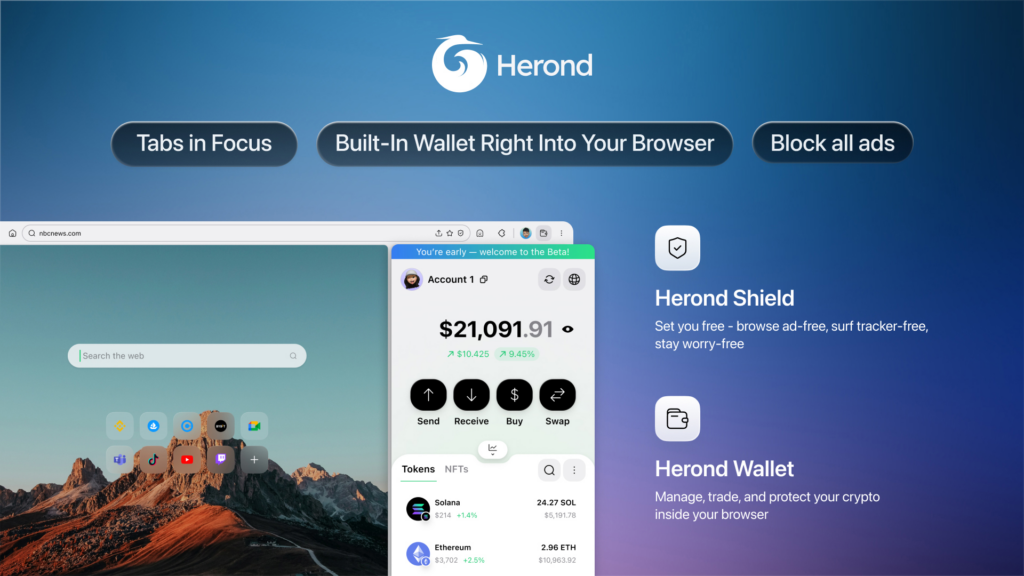
Herond Browser is a cutting-edge Web 3.0 browser designed to prioritize user privacy and security. By blocking intrusive ads, harmful trackers, and profiling cookies, Herond creates a safer and faster browsing experience while minimizing data consumption.
To enhance user control over their digital presence, Herond offers two essential tools:
- Herond Shield: A robust adblocker and privacy protection suite.
- Herond Wallet: A secure, multi-chain, non-custodial social wallet.
As a pioneering Web 2.5 solution, Herond is paving the way for mass Web 3.0 adoption by providing a seamless transition for users while upholding the core principles of decentralization and user ownership.
Have any questions or suggestions? Contact us:
- On Telegram https://t.me/herond_browser
- DM our official X @HerondBrowser
- Technical support topic on https://community.herond.org