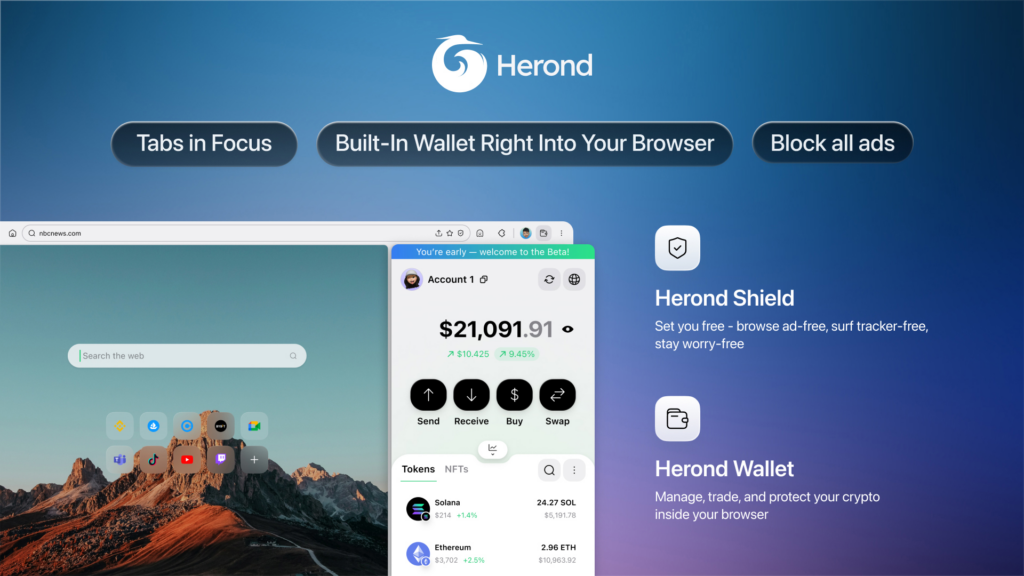


The digital landscape has shifted from passive protection to active utility, sparking a “clash of titans” between the established Brave Browser and the agentic newcomer, Herond. While both are built on a Chromium foundation, this Herond Browser review highlights a growing preference for a Brave Browser alternative that moves beyond basic privacy to solve common Brave Browser Web3 problems like fragmented extension dependency. In 2026, being a private browser is merely the baseline; users now demand a browser better than Brave that acts as an intelligent partner. In the Brave vs Herond debate, the focus has moved from merely blocking ads to providing seamless, automated execution in a decentralized world.
Brave vs Herond: side-by-side feature comparison (2026)
| Feature | Brave Browser | Herond Browser |
| Ad-Blocking Engine | Brave Shields: High-speed native Rust engine; aggressive cosmetic filtering. | Herond Shield: Focuses on AI-driven tracker detection and on-chain threat blocking. |
| AI Integration | Leo AI: Assistive chat for page summaries, translations, and private queries. | Herond AI: Agentic workflows (can execute on-chain swaps, book travel, or organize data). |
| Wallet Tech | Standard Web3 Wallet: Extension-style logic integrated into the core browser. | Keyless MPC Wallet: Native Multi-Party Computation (no seed phrase, higher security). |
| Core Engine | Chromium 143+: Heavy focus on performance & battery life optimizations. | Chromium 143+: Optimized for “Agentic” browsing and zero-extension architecture. |
| Web3 Access | Bridge Model: Connects to dApps via standard provider injection. | Native Native: Built-in multi-chain automation (cross-chain swaps handled by AI agents). |
| Identity Model | Anonymous Identity: VPN & private search without an account. | Universal ID: Uses your wallet as a global login with “Privacy Shield” masking. |
Ad blocking: same Chromium engine, different results?
Native Integration & Manifest V3
While many browsers struggle with Google’s Manifest V3 restrictions, both contenders bypass these limitations by building their ad-blocking engines directly into the Rust/C++ core. This makes Herond a formidable Brave Browser alternative, as both platforms handle filtering at the engine level rather than relying on vulnerable extensions. By baking the logic into the browser itself, they ensure that privacy remains a permanent feature rather than an optional add-on.
The Speed Gap: Predictive Preloading
In a Brave vs Herond speed test, the difference often comes down to how data is managed before the page even loads. While Brave relies on high-speed filtering, Herond utilizes Predictive Preloading to anticipate your next move. This makes ad-blocked pages feel significantly faster, as the browser “pre-cleans” the content before it hits your screen. For users seeking a browser better than Brave for raw browsing speed, this proactive architecture minimizes the “blank space” delay often seen during heavy filtering.
Cosmetic Filtering and Anti-Adblock Scripts
Dealing with aggressive “anti-adblock” pop-ups on sites like YouTube is a major pain point. This Herond Browser review finds that while Brave uses a traditional “Shields” approach, Herond employs a more dynamic cosmetic filtering system. It actively rewrites page elements in real-time to hide empty ad containers and bypass detection scripts more effectively. This solves some common Brave Browser Web3 problems where sites occasionally break or detect the ad-blocker, providing a smoother, truly private browser experience on high-traffic news and media platforms.
Network Privacy: VPN vs. Secure Proxy
The two take different paths toward total anonymity. Brave offers a traditional VPN and Tor-integrated tabs for deep concealment. In contrast, Herond focuses on IP Protection and secure proxy routing designed specifically for 2026’s decentralized web. This allows you to mask your digital footprint while maintaining the high speeds required for dApp interactions, proving that a modern private browser must balance total invisibility with the performance needed for complex Web3 workflows.
Crypto wallet: BAT rewards vs Herond Keyless Wallet
| Feature | Brave Browser | Herond Browser |
| Philosophy | The Attention Economy: Focuses on privacy by stripping ads and rewarding users with BAT. | The Agentic Era: Focuses on utility by automating Web3 workflows and providing “one-click” execution. |
| Ad-Blocking Tech | Brave Shields: Native Rust engine that aggressively blocks trackers and ads. | Herond Shield: AI-driven filtering that identifies trackers and provides real-time “clean room” security. |
| AI Integration | Leo AI: A powerful chatbot for summaries and research within a sidebar. | Herond AI: An “Agentic” partner that can perform tasks (swaps, bookings, data extraction) on your behalf. |
| Wallet Security | Seed-Phrase Based: Traditional self-custody requiring 12-24 words for recovery. | Keyless MPC Wallet: Multi-Party Computation allowing social/biometric login with no single point of failure. |
| Web3 Logic | Bridge Model: Requires standard “Connect Wallet” prompts and extension-style logic. | Native Execution: Zero-extension architecture with built-in multi-chain and gas optimization. |
| Performance | High-speed Chromium optimization with background process limiting. | Predictive Preloading: AI anticipates your next move to load pages faster than standard filtered browsing. |
| Privacy Edge | Network Concealment: Built-in VPN and Tor-integrated private tabs. | IP Protection: Secure proxy routing designed for high-speed dApp interactions without detection. |
| Main Drawback | “Bloatware” concerns: Frequent integration of extra features can feel cluttered to some. | Learning Curve: Transitioning to “Agentic” browsing takes a moment to master. |
DeFi and Web3 experience: which browser wins?
The Agentic Edge: Execution vs. Information
In 2026, the real differentiator between browsers is the ability to act. While Brave’s Leo AI provides an excellent chat interface for summarizing articles, Herond takes it a step further with true Agentic AI. This Herond Browser review highlights how its AI can proactively assist in transactions, analyzing smart contracts for hidden risks and summarizing DeFi yields across protocols in real-time. For power users, Herond is a browser better than Brave because it moves beyond conversation to execution, acting as a digital employee that helps you navigate complex financial data without leaving your tab.
dApp Connectivity: One-Click Freedom
Testing “One-Click” connections on major platforms like Uniswap, OpenSea, and Raydium reveals a shift in Web3 ergonomics. Many Brave Browser Web3 problems stem from a traditional “connect wallet” logic that still feels like a bridge between two worlds. Herond, acting as a total Brave Browser alternative, utilizes a zero-extension architecture that makes dApp interactions feel native. In a Brave vs Herond head-to-head, Herond’s ability to instantly recognize and link with decentralized applications provides a frictionless experience that makes it the preferred private browser for high-frequency traders and NFT collectors alike.

Cross-Chain Fluidity: Ending Extension Fatigue
Navigating between Layer 2s like Arbitrum and Optimism, or jumping to non-EVM chains like Solana, often results in “Extension Pop-up” fatigue in standard browsers. Herond solves this by integrating multi-chain logic directly into its core engine. This allows for seamless cross-chain fluidity where the browser automatically handles network switching and gas optimization. While Brave has made strides in Solana integration, Herond remains the more agile private browser, offering a unified interface that eliminates the constant barrage of approval windows, solidifying its position as a next-generation tool for the decentralized web.
Verdict: who should switch from Brave to Herond?
The “Stay with Brave” User: Privacy via the Attention Economy
If your browsing habits center around earning while you learn, the Brave Browser remains the industry veteran. These users prioritize a long-established privacy tool and the ability to accumulate BAT rewards for viewing first-party ads.() For many, Brave’s “Shields-up” philosophy and independent search index offer a comfortable, battle-tested environment.() However, while it is a robust private browser, those deeply embedded in the 2026 DeFi landscape may find that its reward-based model doesn’t always solve specific Brave Browser Web3 problems like fragmented extension pop-ups or complex multi-chain navigation.
The “Switch to Herond” User: The Agentic Powerhouse
For those seeking a browser better than Brave in terms of pure execution, Herond offers a compelling path forward. This Herond Browser review identifies three primary personas ready for the switch:
- DeFi Power Users: If you want a keyless, extension-free experience, Herond’s MPC (Multi-Party Computation) technology eliminates seed-phrase anxiety. It serves as a seamless Brave Browser alternative by integrating a native wallet that handles swaps and cross-chain transfers without the constant barrage of approval windows.
- AI Seekers: For users who want their browser to act as an active agent rather than just a passive search bar, Herond’s AI moves beyond simple chat.() In a Brave vs Herond comparison, Herond’s “Agentic” capabilities allow it to analyze smart contracts and automate on-chain tasks, providing utility that a standard sidebar assistant cannot.
- Speed Enthusiasts: Leveraging the Chromium 2026 standard, Herond utilizes predictive preloading to deliver an “Instant Web” feel. This proactive approach to data means pages load faster and more cleanly, making it a top-tier choice for those who value raw performance and deep Web3 integration in a single, secure private browser.
Conclusion
In 2026, the Brave vs Herond debate centers on whether you need a protective shield or an active digital employee. While Brave remains a top-tier private browser for earning rewards, many are turning to Herond as a Brave Browser alternative to solve common Brave Browser Web3 problems like extension fatigue and complex key management. This Herond Browser review confirms it is a browser better than Brave for users prioritizing “Agentic” utility, offering a keyless wallet and automated cross-chain workflows that transform the web from a passive experience into an efficient, one-click reality.
About Herond
Herond Browser is the new AI browser, prioritizing privacy for a safer, faster, and smarter browsing experience with minimal data use. Built for the Web2-to-Web3 shift, it enables you to access the open web while you own your data, private Web3 assets, and earn true value.
To enhance user control over their compound experience, Herond offers:
- Herond AI: A new agentic browser that leads your workflow.
- Herond Shield: A robust adblocker and privacy protection suite.
- Herond Wallet: A secure, multi-chain, non-custodial social wallet.